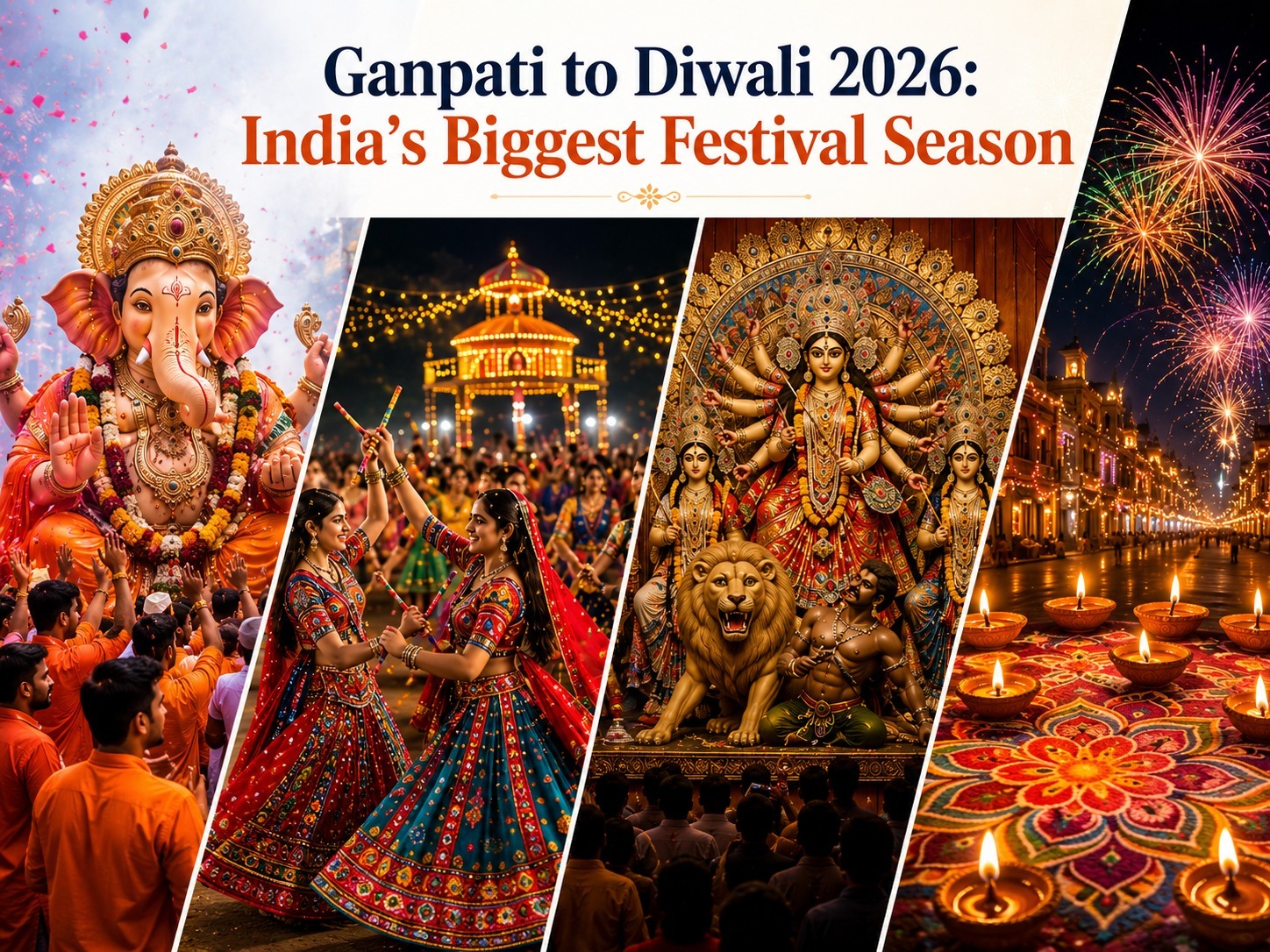
There is a stretch of about eight weeks in India when the whole country seems to be celebrating something. It starts with Ganpati arriving in September, moves into nine nights of Navratri, peaks with Dussehra, and ends in the lights and noise of Diwali.
For most of us, it is a season of family, food and travel. For anyone in business or marketing, it is the busiest and most important window of the year.
Here is a simple guide to the four big festivals coming up, when they fall in 2026, and what each one really means on the ground.
The four festivals and their 2026 dates
Festival | Date in 2026 | How long it runs | Celebrated most in |
Ganesh Chaturthi | 14 September | 10 days, ending 25 September | Maharashtra, Karnataka, Goa, Telangana |
Sharad Navratri | 11 to 19 October | 9 nights | Gujarat, Maharashtra, North India |
Durga Puja and Dussehra | 17 to 20 October | 4 days | West Bengal, Odisha, Assam, and Dussehra pan-India |
Diwali | 8 November | 5 days, from Dhanteras on 6 November | Pan-India |
Because of an extra month in the Hindu calendar this year, all four festivals fall later than usual. That gives everyone a slightly longer runway to prepare, and it also means the festive rush is packed tightly into September, October and early November.
Ganesh Chaturthi: ten days of community
Ganpati is not a one-day festival. It is ten days of pandals, aartis, visiting friends’ homes, modaks, and finally the visarjan procession that brings entire cities onto the street.
What makes it different is how public it is. Mandals are run by local communities. Neighbourhoods compete on decoration. Lakhs of people walk through pandals every evening. If you are trying to reach people in Maharashtra, this is ten uninterrupted days of a captive, cheerful, out-of-home audience.
For brands, the practical opportunities are pandal and mandal associations, sampling near high-footfall pandals, hydration and rest points on visarjan routes, and content built around real community moments rather than a stock Ganpati graphic.
Navratri: nine nights of energy
Navratri changes character depending on where you are. In Gujarat it is garba and dandiya until well past midnight. In Bengal, the same days become Durga Puja, with pandal hopping, street food and new clothes. In North India it is fasting, jagratas and Ramlila performances.
One thing is common everywhere: people buy. New outfits, jewellery, beauty products, gifts, home decor. It is also when a lot of families make their first big purchase of the season, because Navratri is considered auspicious for buying.
If your audience is young, Navratri is probably your strongest social media window of the year. The content is already being created by the audience. Your job is to be part of it, not to interrupt it.
Dussehra: the day people finally buy
Dussehra, on 20 October this year, is a single day but a heavy one commercially. It is traditionally an auspicious day to start something new, so it drives vehicle bookings, electronics purchases, property registrations and new business openings.
It is also emotionally simple. Good wins over evil. That gives brands a clean, universal story to work with, which is why Dussehra creative tends to travel well across regions and languages.
Diwali: the season’s biggest week
Diwali on 8 November is the peak. The five days from Dhanteras to Bhai Dooj carry the highest buying intent of the entire year in India, across almost every category, from gold and appliances to sweets, apparel and corporate gifting.
Two things worth remembering about Diwali:
- Dhanteras, on 6 November, is often a bigger sales day than Diwali itself, especially for gold, silver, utensils, appliances and vehicles.
- Buying continues for several days after Diwali. Bonuses arrive late, gifting continues, and people return to complete purchases they postponed.
Most brands stop spending on the day of Diwali. That is usually a mistake.
How the season connects
It helps to see these four festivals as one continuous journey rather than four separate campaigns.
- Ganesh Chaturthi is when people step out and the mood shifts. Good time to build awareness cheaply, before the rush.
- Navratri is when interest and shortlisting happen. People are researching, browsing and comparing.
- Dussehra is the first big spending trigger.
- Diwali is where the money actually lands, in a very narrow window.
If you build audiences in September, you can talk to them cheaply in November. If you start in late October, you will be bidding against every other brand in the country on the most expensive days of the year.
A simple plan for the season
- August and early September: decide the idea, book media and on-ground spaces, start production.
- Ganpati window: awareness content, video, on-ground presence, community tie-ups.
- Navratri window: creator content, product films, regional-language campaigns, catalogue and collection launches.
- Dussehra week: offers go live, search and shopping campaigns at full strength.
- Dhanteras to Bhai Dooj: heavy retargeting, WhatsApp, store and quick-commerce push.
- The week after Diwali: keep spending. The tail is real and it is profitable.
Three things that make festive campaigns work
Speak the local language, properly
A Marathi line for Ganpati and a Bengali line for Durga Puja will always beat one English campaign translated four ways. Festive emotion does not survive translation.
Give people something, do not just sell to them
Water on a visarjan route. A phone charging point at a garba ground. A rest stop for people travelling home. Small acts of usefulness are remembered far longer than a discount banner.
Do not look like everyone else
Every brand in the country will use diyas, marigolds and the same shade of orange. Keeping your own brand colours and your own voice is the easiest way to stand out during festive clutter.
Frequently asked questions
When is Ganesh Chaturthi in 2026?
Ganesh Chaturthi falls on 14 September 2026, and the ten-day festival concludes with Anant Chaturdashi and visarjan on 25 September.
When are Navratri, Dussehra and Diwali in 2026?
Sharad Navratri runs from 11 to 19 October, Dussehra falls on 20 October, and Diwali is on 8 November 2026, with Dhanteras on 6 November.
Why are the 2026 festival dates later than usual?
The Hindu calendar had an extra month, Adhik Maas, earlier in 2026. That pushes most lunar festivals roughly two to three weeks later than they fell in 2025.
Which of these festivals is most important for brands?
Diwali, in terms of pure sales. But Ganesh Chaturthi and Navratri are where the cheaper attention is, which is why the strongest campaigns start there and finish at Diwali.
Planning your festive season?
Mindwave Media has spent close to two decades running on-ground activations at some of India’s largest gatherings, along with OOH, digital and content campaigns for brands across India and the UAE. If you want a festive plan mapped from Ganpati to Diwali instead of assembled in the last week, get in touch.
Mindwave Media
Website: mindwavemedia.co.in
Email: enquiry@mindwave.co.in
Phone: +91 83909 00611